
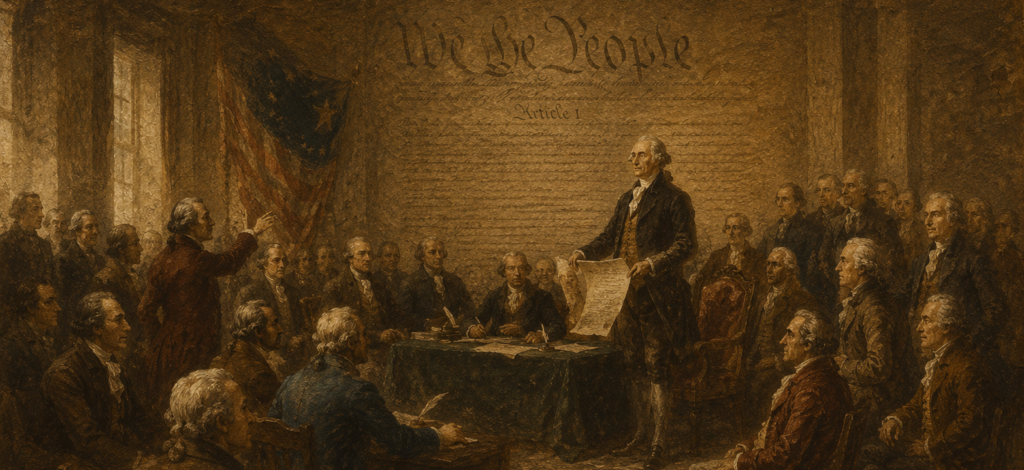
The Oratory and the Republic, by Dani Landivar and Jack McPherson
Industrializing Turin, Italy, was not a humane place. Outside of early education and religious life, human life in Turin largely consisted of exhaustive labor, isolation, and seemingly institutionalized suffering. Sweatshop factories, staffed with hazardous machinery, had become hubs for child labor. The poverty-stricken, abandoned young men and boys who over the previous years had flocked to Turin looking for work were instead turning to crime and mischief, reacting to this brave new world of starvation-wages with a certain angst.
Father Don Bosco looked at these boys and saw neither abstractions nor criminals-in-waiting. He saw souls that had not yet been formed. His answer was not merely to found an orphanage, though these boys would eventually need beds. He built an Oratory: a living environment of prayer, friendship, work, and community. Bosco’s genius was to reach boys before vice hardened into habit, surrounding them with a culture in which goodness could take root. His Oratory was a place where it became easier to be good and harder to be bad. Bosco’s Oratory is a penetrating political commentary. What would it look like for an entire society to make virtue easier and vice harder?
The American polity, it must be asserted, wrestles with this same question. Liberty is not the power to do whatever the will desires, but the freedom and fullness which arises out of loving and doing what is right and just. Early American Christian Minister John Winthrop, who articulated the “twofold liberty, natural…and civil or federal”, was not defending a leviathan stacked atop a morally neutral people. Rather, he reaffirmed man’s capacity for charity as a limiting principle to his capability for depravity. William Penn depicted the same such notion in his Frame of the Government of Pennsylvania, writing that “Governments rather depend upon men than men upon government.” In other words, societies cohere not by force of will, but by the inner life of the people, cultivated not by coercion but by invitation to the good life.
This political principle stems from an anthropological notion of man’s indispensable need for family, society, and religion. Politically, this need is answered in the balance between rights and responsibilities. In this sense, rights and responsibilities are each gifts, through which a person may live fully and freely, rather than asserting the self in a state of brutish nature.
Further, and radically, the Declaration of Independence affirms how rights come not from government, but rather governments protect rights because they are gifts of the laws of nature and nature’s God. This is the principle out of which comes the American Bill of Rights, and it is the double-presumption of rights and responsibilities as gifts which produce each recognized right. Free speech presumes responsibility to truth. Religious liberty presumes responsibility of conscience. The right to bear arms presumes discipline and restraint. Due process presumes a people willing to uphold justice even when passion demands vengeance.
Every right carries a responsibility because every right protects a relationship–the relationship between husband and wife, parent and child, neighbor and neighbor. A society that abandons this notion will eventually demand from a leviathan what only families, churches, schools, and neighborhoods can provide: formation. And a leviathan trusted with formation only forms people who will submit to self-interested power.
This is the penetrating commentary that Don Bosco’s Oratory makes, for Turin’s orphaned boys did not become freer by the removal of restraint, but by entering a common life ordered toward their flourishing. Prayer, friendship, work, discipline, worship, and play were not competing realities–they were the whole point. Bosco made life intelligible by placing the most vulnerable inside a world of love, purpose, and belonging. For them, he inculcated an ecology of liberty.
An ecology of liberty such as Bosco’s, and such as described by Winthrop and Penn, is the only adequate milieu out of which humane constitutions arise. Such is the case for the American Constitution with its Bill of Rights, and though it is not an Oratory, nor a substitute for the moral formation of the people, it is a legitimate vessel for protecting the God-given rights of the person. It gives room for families to form children, for church to form consciences, for neighbors to practice charity, and for citizens to govern themselves. Therefore it can be said that the praxis of the American Constitution is operating as designed if the American people experience their regime not as a society of licentiousness, but as a world of freely chosen virtue.