
The Integrated Servant Leader by ELP Administrator, Dani Landivar
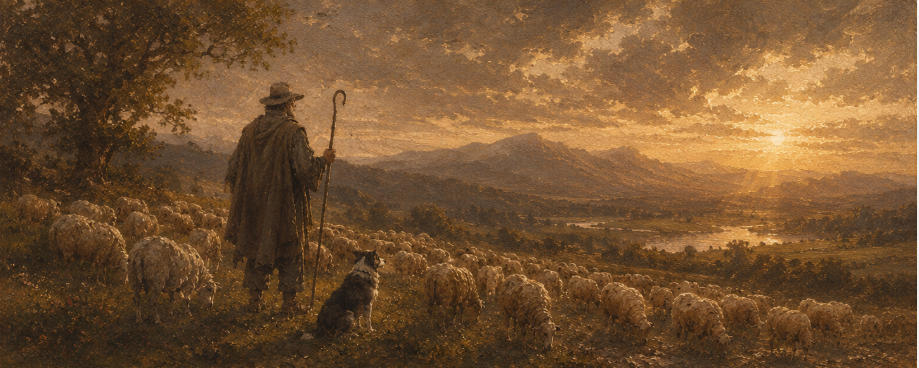
A shepherd and his sheepdog overwatched their flocks from a large grassy knoll. It was the sheepdog’s birthday, and with the passing of another year, he no longer felt like a young pup, but a stronger and more experienced dog. Filled with excitement, he strode across the field toward the sheep. He shook out his thick coat and let out a deep woof as if to announce his presence among them. Yet the sheep paid him no mind.
Annoyed by their indifference, the sheepdog began prancing up and down the line, hoping to impress them, but still they ignored him. Finally, desperate to be noticed, he began circling them wildly. This time he succeeded. The sheep erupted into panic. Some scattered into trenches, others became trapped among rocks, while the rest fled wildly across the field.
The shepherd, having watched the whole scene unfold, calmly walked toward the frightened sheep. One by one, he lifted those stuck in trenches, guided those caught among stones, and gathered the scattered flock back together. When peace had finally returned to the field, the shepherd turned to the sheepdog and said:
“A true shepherd is not the one who makes the sheep tremble in his presence, but the one who bears responsibility for their well-being. Leadership is not proven by being noticed, but by serving others faithfully.”
In an age where leadership is often perceived as a matter of charisma, talent, or visibility, comes the reality that not all who wield authority are truly transformational leaders. That is because transformational leadership is never merely external; it flows from the inner life. That’s why a fragmented person will inevitably make a poor leader—no matter what position they hold—because who we are always precedes what we do. The leader cannot rise above the condition of their own soul.
And the condition of the soul is first determined by what it is rooted in.
The apostle Paul warns in Colossians 2:8 against being taken captive by philosophy or empty deceit. The problem is not philosophy itself, but philosophy detached from Truth. He prefaces this warning by calling believers to be rooted and built up in Christ because whatever we root ourselves in will inevitably shape us. Roots always determine fruit.
What are you rooted in right now?
Achievement? Recognition? Influence? Approval? Performance?
And if those things disappeared tomorrow, who would you be?
What we are rooted in shapes our identity. If identity is rooted in anything temporal, then the soul becomes unstable because temporal pursuits cannot sustain or satisfy eternal souls. Our souls need to be rooted in something transcendent. Something eternal. That’s why Jesus Christ taught us to seek first the eternal Kingdom of God, to pursue His righteousness, and, as a result, all earthly things will be added to us.
When our identity is rooted in Christ, we begin to see ourselves from His perspective rather than our own distorted one. The Creator reveals Himself to His creation—showing them who He is, who they are, and what they were made for.
Do you know who you are apart from what you produce? Apart from how people perceive you? Apart from your successes or failures?
Our identity shapes our perspective of ourselves and others. When we are rooted in Christ, we are freed from seeing ourselves through the lens of insecurity, pride, comparison, or performance. And from there we are also able to evaluate others “according to the flesh no longer” (2 Corinthians 5:16), but through the lens of God’s design and dignity.
The integrated person knows themselves and others as God sees them. That is why Jesus also said:
“And you shall love the Lord your God with all your heart, with all your soul, with all your mind, and with all your strength… and you shall love your neighbor as yourself.” — Mark 12:30–31
Once our identity is rooted in the eternal, it produces what Augustine called ordo amoris — rightly ordered loves. Augustine argued that virtue is not merely loving, but loving the right things in the right order. Love begins with proper order. God first, then self rightly understood through God-given identity, and from there, neighbor rightly loved. From the place of having the first three loves in proper order — God, self, and neighbor — all other temporal loves can follow suit and be properly ordered. From this place the process of integration begins to sprout.
Integration is the proper ordering of the soul—when our loves, desires, reason, and actions move in the same direction. Plato taught integration as harmony within the soul: reason rightly governing spirit and appetite. The integrated person is not divided against themselves. Their inner life and outward mission are aligned toward the same telos. They do not need constant recognition because their identity is already rooted deeply enough to serve without applause.
In Judges 6:24, Gideon gives the Lord the name Jehovah-Shalom. The Hebrew word shalom comes from shalam, meaning “to be made complete.” Shalom is more than the absence of conflict. It is integration, wholeness, peace, flourishing, and creation rightly ordered as God intended it to be.
This is what the rooted and integrated life ultimately produces: a soul no longer fractured by disordered loves or enslaved to self-interest. The person living in shalom is freed from self and freed for others.
The servant leader does not use people for personal advancement because they do not rely on people to sustain their identity. Their influence becomes stewardship rather than self-exaltation. They bear responsibility for others rather than demanding recognition from them. They seek the flourishing of those they lead because love has reordered the posture of their soul outward rather than inward.
In the end, the integrated leader understands what the sheepdog could not: good leadership is not measured in being noticed or praised, but in faithfully bearing responsibility for others.
Dear reader, you have so much potential to become a leader who truly changes lives — beyond any accolade you could receive, beyond the number of people you could lead, beyond simply what you do. But before asking what kind of leader you will become, perhaps the deeper question is this: what kind of person are you becoming?
I want to encourage you to look inward right now. Is there any part of your life being governed by insecurity? Is there any part of you that is not rooted in truth?
If so, go to your Creator. Ask Him to reveal Himself to you. Properly understand who He is, and then ask Him to reveal who you are in Him.
Because only the person rooted in Truth can be whole.
Only the whole person can selflessly serve.
And only the true servant can be a transformational leader.