
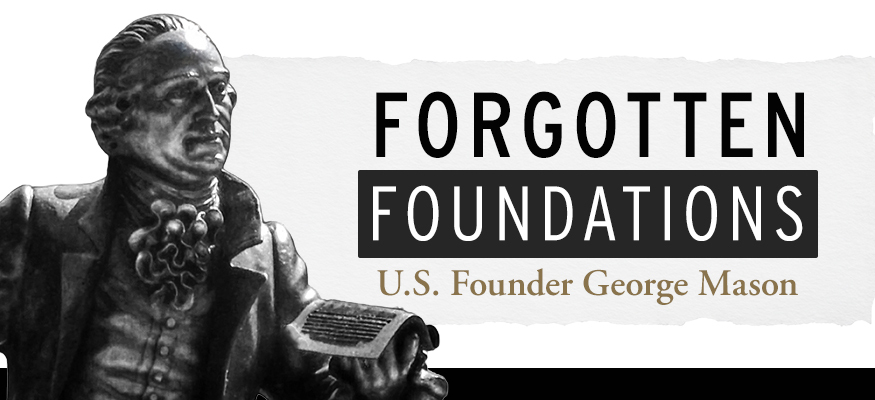
Forgotten Foundations – Jake Fay
George Mason was wrong, wise, misguided, and discerning.
The great Virginia statesman who adorned the Constitution with the Article V convention bulwark against federal tyranny blasted the new system of government as a close neighbor to tyranny and ultimately opposed the Constitution. After withholding his signature from the document at the 1787 Constitutional Convention, Mason returned to the Old Dominion to protest its adoption at the Virginia Ratifying Convention.
To his credit, the Patron Saint of Article V believed that the proposed Constitution should be sent to the people and states for their approval. Should “any Attempt be made to prevent the calling [of] such a Convention here, such a Measure shall have every Opposition in my power to give it,” Mason vowed in a letter to George Washington. As he explained to the soon-to-be first president of the United States, his objections to the new Constitution were not “numerous,” but they were “capital.”
He felt confident that the document could be salvaged, but he could not, in good conscience, support it in its present condition.
As 170 Virginia statesmen packed into their state capitol building before moving due to size constraints, the earth must have trembled at the collective powers of oratory and reason assembled in the room. The stage was set for a vigorous clash between world-class rhetoricians, theorists, and philosophers who prided themselves on their ability to outthink, outdebate, and outsmart their opponents. One group, the anti-Federalists, rallied in opposition to the proposed “consolidated government,” arguing that it disrupted their preferred state-based confederation. The Federalists defended the document against an unremitting storm of criticism and argued that a “General Government” was both necessary and proper.
Mason and Patrick Henry led the anti-Federalist charge. Although history has sided with the Federalists and the Constitution, the Mason-Henry coalition articulated many worthwhile points about federalism, the perils of centralized power, and the need for stringent safeguards against tyranny. Their direct prescriptions may have been wrong, but their insights were perceptive.
On June 4, 1788, Mason rose to address the convention about the new Constitution’s perceived imbalance of power. Laying out the principles of subsidiarity, he gawked at the federal government’s predominance over the states. “The General Government being paramount to, and in every respect more powerful than, the State governments, the latter must give way to the former,” he said.
Although the United States was (or, perhaps, were) only a fraction of the size it would become, the Virginian planter scoffed at the notion that a single republican government could ever encompass such a wide array of regional interests without collapsing into tyranny. “Is it to be supposed that one National Government will suit so extensive a country, embracing so many climates, and containing inhabitants so very different in manners, habits, and customs?” he asked. “It is ascertained by history, that there never was a Government, over a very extensive country, without destroying the liberties of the people.”
“[P]opular Governments,” he asserted confidently, “can only exist in small territories.”
Mason drew this conclusion from the pages of history, but apparently failed to consider: had a popular, republican government ever been tried before on such a sweeping scale? Future frontier scholars and proponents of Westward Expansion later argued that America’s continental arena for growth had actually fortified, not undermined, her liberal tendencies and antipathy to federal control.
Over 40 years after the Virginia Ratifying Convention, state delegates again assembled for the Virginia Constitutional Convention of 1829-1830 to patch over contentious internal disputes. At this synod of the fabled Virginia gentry, a delegate from the western part of the state leveled an explosive indictment at the Mason archetype of a statesman. Heralding the “increase of population in the West” as a boon to democracy, he suggested, quite shockingly, that the state’s vaunted old guard was, in fact, inferior to the rising Western class.
“The Old Dominion has long been celebrated for producing great orators; the ablest metaphysicians in policy; men that can split hairs in all abstruse questions of political economy. But at home, or when they return from Congress, they have negroes to fan them asleep. But a Pennsylvania, a New York, an Ohio, or a western Virginia statesman, though far inferior in logic, metaphysics, and rhetoric to an old Virginia statesman, has this advantage, that when he returns home he takes off his coat and takes hold of the plow. This gives him bone and muscle … and preserves his republican principles pure and uncontaminated.”
Mason feared that the breathtaking scope of the fledgling American empire would render limited government impossible. It seemed impractical that a single national authority could ever accommodate so many irreconcilable differences — differences that had been on full display at the heated Constitutional Convention. In reality, those glaring dissimilarities and a growing strain of frontier individualism forced the government deeper into its own tradition of subsidiarity and federalism.
The anti-Federalists protested that a national government would trample the states, but the Framers had taken just about every reasonable precaution to prevent that eventuality. As James Madison, the Father of the Constitution, insisted in Federalist No. 45, “The powers delegated by the proposed Constitution to the federal government are few and defined. Those which are to remain in the State governments are numerous and indefinite.”
Unfortunately, Mason and his allies refused to listen.
“Is this general representation to be compared with the real, actual, substantial representation of the State Legislatures?” the author of the Virginia Declaration of Rights asked. “It cannot bear a comparison. To make representation real and actual, the number of Representatives ought to be adequate; they ought to mix with the people, think as they think, feel as they feel, ought to be perfectly amenable to them, and thoroughly acquainted with their interest and condition [all of which would be implausible ‘in so extensive a country as this’].” Without the close bond between politicians and their constituents that only state legislatures could provide, “we have no real, actual, substantial representation….”
Mason’s June 4, 1788, speech sheds invaluable light on the Framers’ concordant support for the Article V convention clause, which enables state legislatures to gather in a convention to propose amendments to the federal system. Those amendments, ardent Federalist Alexander Hamilton said, would form “barriers against the encroachments of the national authority.”
This general circumspection about undermining the state authorities formed the basis for the American system of government, whether Mason could see it or not. He may have been unreasonably wary of the new Constitution, but his misgivings about oppressive federal power reflected mainstream sentiments that proved formative to the document.
In the end, Mason failed to anticipate just how truly extraordinary the American system would become. “It is ascertained by history, that there never was a Government, over a very extensive country, without destroying the liberties of the people,” he warned the Virginia Convention. It wasn’t enough: three weeks later, Mason’s colleagues voted 89 to 79 in favor of ratification. America, under the U.S. Constitution, would prove him — and history — wrong.