
In Act III of the new film by Sight and Sound Theatres, A Great Awakening, Benjamin Franklin clashes with British Admiral Richard Howe over whether the American colonies are capable of self-governance.
Howe, aristocratic and proud, says no. The Americans are “utterly incapable of handling freedom.”
Dr. Franklin, on the other hand, contends that the people who sent him to London to negotiate for peace are both “moral” and “self-governing.” And “awakened.”
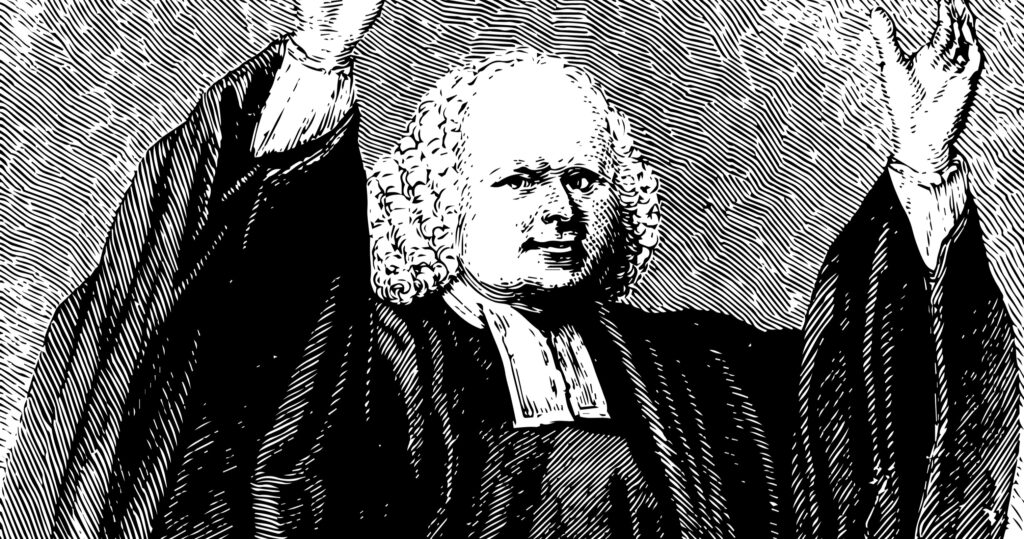
The film strongly insinuates that the American inventor, printer, and statesman believes this only because of the inimitable career of a certain fire-breathing Protestant preacher, George Whitefield, who tore through the colonies like a human force of nature, bellowing gospel truths like cannon fire.
In many ways, the movie revolves around this central question: what does it mean for a people to be self-governing? In real life, Franklin’s answer to that question would have differed vastly from Whitefield’s. The old doctor believed in virtue — the kind of moral code that put Jesus on equal footing with Socrates. (His advice for achieving humility: imitate both.) He was the kind of self-help guru who would dedicate an entire chapter in his Autobiography to a fastidious “PLAN FOR ATTAINING MORAL PERFECTION.” Mapping out 13 essential virtues — the list had grown from only a dozen after a Quaker friend “kindly informed” him that he needed to work on his pride — Franklin rigorously trained his body and mind to “acquire the habitude” of righteousness, tracking his failures and successes on a literal “virtue chart.”
Franklin sheepishly confessed that his “bold and arduous project” of living “without committing any fault at any time” may have sounded like “foppery in morals,” and his intractable pride (among other stubborn vices) tested the limits of his scheme. “Disguise it, struggle with it, beat it down, stifle it, mortify it as much as one pleases, it is still alive, and will every now and then peep out and show itself.” Franklin learned that he could mow the lawn and (perhaps) impress others with a weedless garden, but, beneath the surface, the roots remained. It was Woodrow Wilson who would later identify the plan’s fatal flaw: “Men do not take fire from such thoughts, unless something deeper, which is missing here, shine through them,” he critiqued.
Whitefield, whom the film casts as Franklin’s perfect foil, likely would have approved of that line. In his youth, Whitefield had stumbled upon a kind of religious fanaticism that very nearly killed him. Determined to crucify the flesh in order to please God, the zealous Oxford student had engaged in what the movie calls “a rejection of all earthly pleasures.” “Many nights he lay sleepless upon his bed; many days, prostrate on the ground,” John Wesley, who had recruited the future minister into his “Holy Club,” later remembered of this time period in Whitefield’s life.
Fortunately, after much asceticism, the dark night of the soul finally lifted and, as Whitefield described, “a ray of divine light was instantaneously darted in upon my soul, and from that moment, but not till then, did I know that I must be a new creature.” Many years later, Whitefield remembered his alma mater as the “place where Jesus Christ first revealed himself to me, and gave me the new birth.”
That was the kind of religious rhetoric — “new creature,” “new birth” — that set Whitefield’s gospel-based worldview apart from Franklin’s man-driven pursuit of moral excellence. The latter lacked “fire.” But not so with Whitefield. As Charles Spurgeon once said, “He lived; other men seem only to be half alive; but Whitefield was all life, fire, wing, force.”
Rather than cooling Whitefield’s ardor, the revelation that all men must be born again — not merely religious — set him on the warpath for the gospel. Cast out of lukewarm churches for his untamable elan, the young minister took to preaching to the “unworthy” masses, democratizing faith in true Reformation style. Audiences may haggle over the film’s extraordinary claim that “George Whitefield was the Revolution,” but there can be no doubt that he contributed a powerful ingredient. If mere “commoners” could be self-governing in matters as important as their faith, what else might they take into their own hands?
Actor Jonathan Blair turns in a worthy performance as the preacher whose booming voice could be heard — according to Franklin’s calculations — by “more than thirty thousand” people at once. But no movie could adequately capture the true breadth of the man’s truly breathtaking career. As one acquaintance recalled, Whitefield spoke “in the compass of a single week (and that for years) in general forty hours, and in very many, sixty, and that to thousands; and after this labor, instead of taking any rest, should be offering up prayers and intercessions, with hymns and spiritual songs, as his manner was, in every house to which he was invited.” When he wasn’t preaching or praying, he was probably traveling on horseback to the next village to tell yet more people about the new birth experience.
Franklin and Whitefield may have taken two very different paths to virtue, but Franklin detected in the young religious celebrity an opportunity — namely, a business opportunity. Whitefield, who had often leveraged the local press back home in England to his advantage, agreed to let Franklin’s Pennsylvania Gazette promote his American barnstorms and print his sermons and journals. Over the course of multiple American tours, Whitefield preached to an estimated 80% of the colonists at least once — a mind-boggling figure probably attributable, at least in part, to his partnership with the Gazette. No doubt, for Franklin, it was a profitable arrangement.
The movie likely overstates the odd couple’s camaraderie — “Ours was a mere civil friendship,” Franklin once remarked — although they continued to correspond over many decades. In one of his last letters to Whitefield, who died on September 30, 1770, Franklin jabbed at his old Calvinist friend over God’s seeming apathy towards the colonists’ deteriorating relations with Great Britain.
“I see with you,” he wrote, “that our affairs are not well managed by our rulers here below; I wish I could believe with you, that they are well attended to by those above; I rather suspect, from certain circumstances, that though the general government of the universe is well administered, our particular little affairs are perhaps below notice, and left to take the chance of human prudence or imprudence, as either may happen to be uppermost. It is, however, an uncomfortable thought, and I leave it.”
Nevertheless, it is true, as the movie concludes, that Franklin delivered a rather Calvinist sounding speech at the 1787 constitutional convention, blessing Providence for intervening on the colonists’ behalf in the War for Independence. “I have lived, Sir, a long time,” he reportedly remarked, “and the longer I live, the more convincing proofs I see of this truth — that God governs in the affairs of men.” Had supernatural events — or Whitefield’s persistent faith — softened the old scoffer? Perhaps.
But this we know for a fact: the Great Awakening that Whitefield championed — and Franklin promoted — brought personal faith, virtue, and a “new birth” to everyday people. All men were created equal before the God of the Evangelical Revival. Admiral Howe could scoff all he wanted; when his legions rolled around for war a few years later, the Americans would prove that they were, indeed, capable of self-governance.