
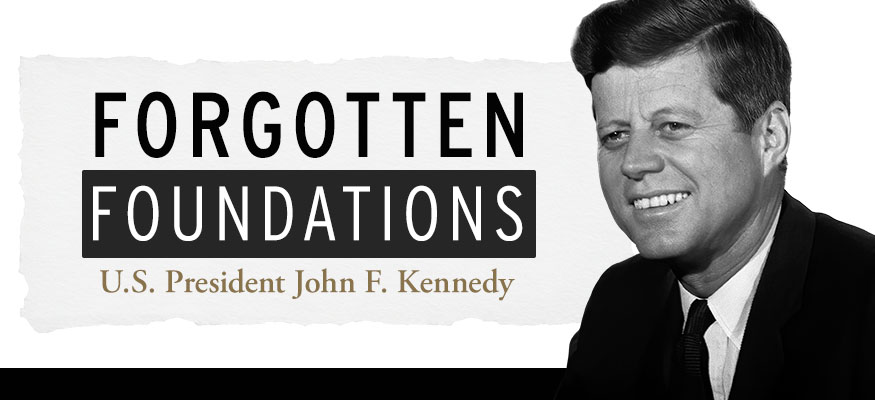
Most everyone is familiar with the speeches and addresses that are considered the greatest in American history: The Gettysburg Address, Washington’s Farewell, the dream of Martin Luther King, Jr. Our new series, “Forgotten Foundations”, will explore political discourse of somewhat lesser renown that not only explains and amplifies the American form of government and our highest ideals as we celebrate our 250th birthday, but calls for further attention and study. The following is the first in the series.
Embarking upon his journey to Washington, D.C., to be inaugurated as the 35th president of the United States and to deliver one of the most stirring and oft-quoted inaugural addresses in American history, John F. Kennedy had an important stop to make on January 9, 1961: Beacon Hill in Boston.
There, in the city where his Irish forebears landed, where his maternal grandfather served as mayor, and where he launched his first political campaign, he addressed the state legislature, formally known as the Massachusetts General Court.
Throughout his public life, Kennedy rarely expressed personal sentimentality. He was the epitome of “cool” as defined by media theorist Marshall McLuhan, an individual ideally suited in style and approach for the new age of television, and his speech to the legislature was carried by Boston television stations.
Kennedy panache was not altogether the case in Boston on that January night. Perhaps feeling the same intensity of responsibility that Abraham Lincoln felt before somberly leaving Springfield, Illinois, for Washington, D.C., a century before, Kennedy recalled his lifelong gratitude for the people of Massachusetts. His voice quavered ever so slightly when he said:
“For forty-three years – whether I was in London, Washington, the South Pacific, or elsewhere – this has been my home; and, God willing, wherever I serve this shall remain my home.”
Those words took on added poignancy on November 22, 1963. But that home was a source of great pride to Kennedy, particularly given the role of Massachusetts in not rooting liberty on this continent, but standing out as an example to all the world:
“Its leaders have shaped our destiny long before the great republic was born. Its principles have guided our footsteps in times of crisis as well as in times of calm. Its democratic institutions – including this historic body – have served as beacon lights for other nations as well as our sister states.
“For what Pericles said to the Athenians has long been true of this commonwealth: “We do not imitate — for we are a model to others.”
“And so it is that I carry with me from this state to that high and lonely office to which I now succeed more than fond memories of firm friendships. The enduring qualities of Massachusetts — the common threads woven by the Pilgrim and the Puritan, the fisherman and the farmer, the Yankee and the immigrant — will not be and could not be forgotten in this nation’s executive mansion.
“They are an indelible part of my life, my convictions, my view of the past, and my hopes for the future.”
As is written in Ecclesiastes, “there is no new thing under the sun.” When Kennedy took the rostrum in the Massachusetts House chamber it was, in the words of Arthur Schlesinger, Jr., a Harvard professor and dean who would serve as a Special Assistant in the Kennedy administration, “a critical moment in Massachusetts politics.”
In a memo and draft that Schlesinger sent to Kennedy concerning his speech, Schlesinger noted that there had lately been “a series of revelations over the past year into the corruption, favoritism and general squalor of our local politics.”
The citizens of the Commonwealth, Schlesinger suggested, “desperately need and would greatly applaud a clarion call of some sort — an affirmation of the need for integrity and civic responsibility…you could appropriately remind the Legislature of their traditions and their responsibilities.”
Kennedy invoked those grand traditions to reinforce to the members of the General Court that they stood upon the shoulders of giants and must strive to serve with wisdom, prudence, and virtue, a timeless reminder for all who are charged with doing the business of the people. He held up his standard of excellence in public life:
“But I have been guided by the standard John Winthrop set before his shipmates on the flagship Arbella three hundred and thirty-one years ago, as they, too, faced the task of building a new government on a perilous frontier.
“’We must always consider,’ he said, ‘that we shall be as a city upon a hill — the eyes of all people are upon us.’
“Today the eyes of all people are truly upon us — and our governments, in every branch, at every level, national, state and local, must be as a city upon a hill — constructed and inhabited by men aware of their great trust and their great responsibilities.
“For we are setting out upon a voyage in 1961 no less hazardous than that undertaken by the Arabella in 1630. We are committing ourselves to tasks of statecraft no less awesome than that of governing the Massachusetts Bay Colony, beset as it was then by terror without and disorder within.”
Kennedy, of course by then acclaimed for his Pulitzer Prize-winning book Profiles in Courage, then asked his fellow public servants questions that he argued would be the measuring stick that history would use to judge their actions:
“First, were we truly men of courage — with the courage to stand up to one’s enemies — and the courage to stand up, when necessary, to one’s associates — the courage to resist public pressure, as well as private greed?
“Secondly, were we truly men of judgment — with perceptive judgment of the future as well as the past — of our own mistakes as well as the mistakes of others–with enough wisdom to know that we did not know, and enough candor to admit it?
“Third, were we truly men of integrity — men who never ran out on either the principles in which they believed or the people who believed in them — men who believed in us — men whom neither financial gain nor political ambition could ever divert from the fulfillment of our sacred trust?
“Finally, were we truly men of dedication — with an honor mortgaged to no single individual or group, and compromised by no private obligation or aim, but devoted solely to serving the public good and the national interest.
With those four questions and the uncharacteristic tinge of public emotion, Kennedy more than reminded the assembled Massachusetts legislators of their heritage and their duty. In fact, the speech was received so well that it is said that his father, Joseph P. Kennedy, Sr., the mastermind of his son’s political career, feared that the forthcoming inaugural address would fail to measure up.
That worry proved unfounded. John Fitzgerald Kennedy’s inaugural address will stand out as long as there is an American republic. Yet few speeches better encapsulate the foundational principles of that republic and the responsibilities that its representatives have to its people as his address to the Massachusetts General Court on January 9, 1961.
As we celebrate the 250th anniversary of our founding, it is appropriate to recall those principles and to keep the spirit of ‘76 alive in holding those who serve us to account and demand that they live up to their responsibilities, so that the United States can indeed be that city on a hill – now and forever.
To listen to the entirety of Kennedy’s speech, click below: