
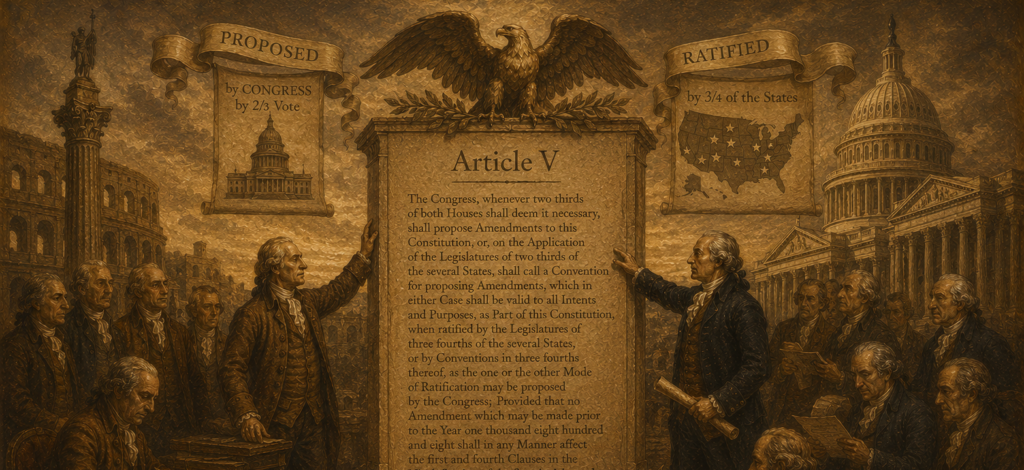
Editor’s Note: This is the third of a three-part series that examines the constitutional role of the States in utilizing Article V of the Constitution as a means of self-correction.
Article V and the States’ Constitutional Power pt. 3 – ELP Strategic Development Manager Jack McPherson
Proposing an Article V convention is not only fitting and legitimate, but it is prudent and urgently necessary here and now.
As this series of articles has demonstrated, the legitimacy of an Article V convention does not arise out of Congressional ineptitude; it arises from within the Constitution itself (yet, Congressional failure helps explain why this constitutional mechanism now deserves renewed attention).
All of the instruments of Federal politics heretofore employed are poorly suited to structural self-correction. Congress has little institutional incentive to propose amendments that restrain its own authority, tenure, spending, or jurisdiction. Presidents inherit and employ the administrative power already accumulated by the Federal government (though it increasingly appears that certain presidents may be unable to control their administrative power). Courts may occasionally check abuses, but no judiciary can serve as the ordinary engine of constitutional restoration.
Is this because the Article V convention is an extraordinary measure by its nature? No. Is this because the Constitutional structures ratified altogether in 1788 are revealing a previously undetectable weakness? No. The ship of Federal politics could work, if the pilots at the helm would steer it rightly. Instead, they don’t do any steering at all. They rather adhere to a form of anticonstitutionalism, living out a culture and a political approach antithetical to that out of which the American republic came.
Constitutional Lawyer and Convention of States advocate Robert Natelson states the problem plainly: the strategy of restoring constitutional limits by concentrating exclusively on Federal elections and Supreme Court appointments has failed; “no Congress or President is likely to do much to restore constitutional limits on federal power”, and judicial efforts will be “marginal, at best”. His proposed alternative centers on Article V: the ability of the people, through their State legislatures, to amend the Constitution in order to rein in a runaway central, Federal government.
This argument does not constitute a rejection of ordinary politics. Elections still matter. Legislation still matters. Courts still matter. If the anticonstitutional sycophants at the helm of the ship can be replaced by yet more faithful sycophants, that would be desired. But none of these measures can substitute for the Constitution’s own mechanism of structural correction. Article V exists because the Constitution does not require the Federal government to be the sole physician of its own disease.
The present Article V convention effort must be understood in that light. Its concern with fiscal restraint, limits on federal power and jurisdiction, and term limits is not a flight from constitutional politics. It is an attempt to recover constitutional politics at the level of structure. To work through Article V is to act within the Constitution’s own architecture for the sake of preserving the conditions of self-government.
This is why Article V should be understood as Federalism at its most excellent. It gathers together the three realities too often pulled apart in American political argument: the people, the States, and the Union. The people remain the source of legitimate political authority. The States give that authority concrete republican form. The Union is preserved, not by suppressing the States, and not by allowing them to stand against the Constitution, but by giving them a lawful role in constitutional correction.
To participate in Article V work, then, is not merely to engage in activism. It is to exercise a legitimate form of political agency within the American regime. It is to act through the Constitution’s own architecture for the sake of preserving the conditions of self-government. Article V does not ask citizens to abandon ordinary politics, nor does it invite them into revolutionary politics. It gives them a constitutional path when structural correction becomes necessary.
The point, finally, is not State power for its own sake. As the Founders articulated, the point of the States, their constitution, Article V, and the whole Federalist system is to preserve the political constitution of the United States: a regime of the people, by the people, and for the people, ordered to human dignity, popular consent, republican self-government, and the blessings of liberty. Article V is not a competition of State sovereignty versus Federal sovereignty. It is an exercise of the people, acting through their States, to preserve the Union by constitutional means.