
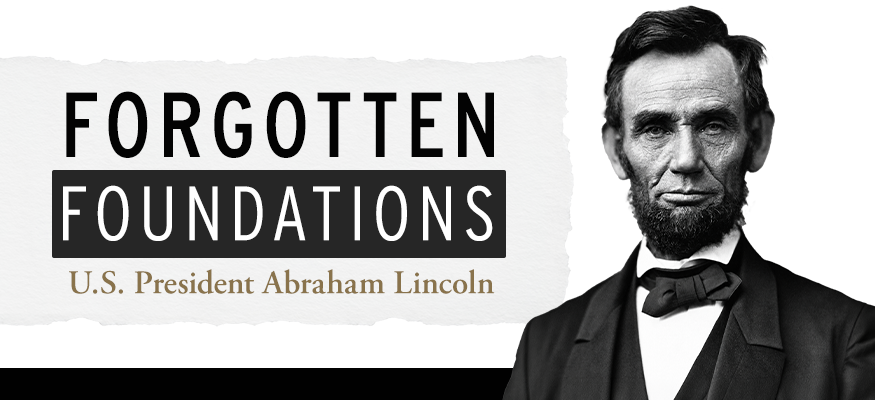
Forgotten Foundations, July 4, 1861 – Jake Fay
The American experiment in liberty was on trial.
The fate of free government, here and everywhere, hung in the balance.
The president of the United States faced an excruciating decision: “Immediate dissolution or blood.”
In his Gettysburg Address, Abraham Lincoln described America as a nation “conceived in liberty, and dedicated to the proposition that all men are created equal.” As such, the Founders had taken every precaution to safeguard freedom from the threat of federal tyranny. Hemmed in by checks and balances, a bill of rights, and a network of overprotective states, the federal government was meant to be limited, insignificant, and aloof. That was — in the Founders’ minds — what it meant to live in a free country.
But could it last?
In the face of a terrible secession crisis and a looming civil war, that was what Lincoln — the lawyer turned president — wanted to know.
The growing conflict between the states “forces us to ask,” he said in a July 4, 1861, address to Congress, “Is there in all republics this inherent and fatal weakness? Must a government of necessity be too strong for the liberties of its own people, or too weak to maintain its own existence?”
In a precursor to a phrase he later refined, Lincoln argued that if “a government of the people by the same people” was doomed to collapse whenever a few “discontented individuals” opposed it, republican principles would be exposed as fundamentally flawed, indefensible. The people had rights, of course — but if those rights included the prerogative to abolish or commit treason against their government flippantly, the very notion of “free government” would disintegrate.
In light of this unnerving prospect, Lincoln had been forced to take action to suppress the southern insurrection. He wanted to prove to the watching world — already lamenting “the early destruction of our National Union” — that limited governments were, in fact, capable of defending themselves.
The sudden mass exodus of southern states was bad enough. To make matters worse, “all the forts, arsenals, dockyards, custom-houses, and the like, including the movable and stationary property in and about them, had been seized and were held in open hostility to this Government….”
Were free governments obligated to surrender their military facilities to domestic rebels? Lincoln said no. As commander-in-chief, he acted decisively to resupply Major Robert Anderson and the Union Fort Sumter in South Carolina. Confederate forces under General P.G.T. Beauregard responded by attacking and seizing the fort.
War had arrived.
On April 15, two days after Fort Sumter fell to the enemy, America’s chief executive announced that he had “no choice … but to call out the war power of the Government,” summoning 75,000 troops “to repossess the forts, places, and property which have been seized from the Union….” He also called for a special session of Congress on “the 4th day of July next.”
But Lincoln couldn’t wait that long. Twelve days later, determined to protect federal lines through Maryland, the president authorized his commanding general, Winfield Scott, to suspend the writ of habeas corpus — a bold move that Chief Justice Roger Brooke Taney challenged as unconstitutional. Granted, the Constitution did allow for the suspension of habeas corpus “in Cases of Rebellion or Invasion,” but that prerogative appeared in Article I, which, as Taney noted, “is devoted to the Legislative Department of the United States, and has not the slightest reference to the Executive department.”
Lincoln was undeterred. Waiting until the July 4th special session, he presented a lawyerly defense of his extraordinary war powers, simply shrugging off Taney’s opinion. The limited case ability to suspend the Great Writ certainly seemed like an executive power, Lincoln argued; after all, “it can not be believed the framers … intended that in every case the [Rebellion or Invasion] should run its course until Congress could be called together, the very assembling of which might be prevented, as was intended in this case, by the rebellion.”
Lincoln’s allies — including Attorney General Edward Bates and lawyer Horace Binney — mounted a fairly compelling case for the constitutionality of the president’s actions, and Lincoln continued to defend (and use) the assumed power throughout his presidency. But, even if it had been unconstitutional, Lincoln wanted to know:
“Are all the laws but one to go unexecuted, and the Government itself go to pieces lest that one be violated? Even in such a case, would not the official oath [that the laws be faithfully executed] be broken if the Government should be overthrown when it was believed that disregarding the single law would tend to preserve it?”
Lincoln reminded his critics that the states, under Article VI of the U.S. Constitution, had all agreed to uphold the “Constitution, and the Laws of the United States” as “the supreme Law of the Land.” Was the U.S. government incapable of enforcing that bedrock of American law on account of the genuine confusion about the suspension clause? If so — if limited governments were impotent in the face of existential crisis — the experiment in liberty was bound to fail.
Lincoln, for one, was adamant never to let that happen. As chief executive, he “had no moral right to shrink, nor even to count the chances of his own life in what might follow.” As for others, he implored them to consider whether the Confederate substitute could ever live up to the 1776 original.
“Our adversaries,” Lincoln noted, “have adopted some declarations of independence in which, unlike the good old one penned by Jefferson, they omit the words ‘all men are created equal.’ Why? They have adopted a temporary national constitution, in the preamble of which, unlike our good old one signed by Washington, they omit ‘We, the people,’ and substitute ‘We, the deputies of the sovereign and independent States.’ Why? Why this deliberate pressing out of view the rights of men and the authority of the people?”
It was all a test of whether a nation “conceived in liberty, and dedicated to the proposition that all men are created equal” could long endure. On July 4, 1861, America’s 85th birthday, that proposition hung precariously in the balance. But Lincoln would give his last full measure of devotion to ensure it wouldn’t fall. Speaking from Gettysburg three years later, the president reasserted his hope, indeed his confidence, “that government of the people, by the people, for the people, shall not perish from the earth.”
Case closed.