
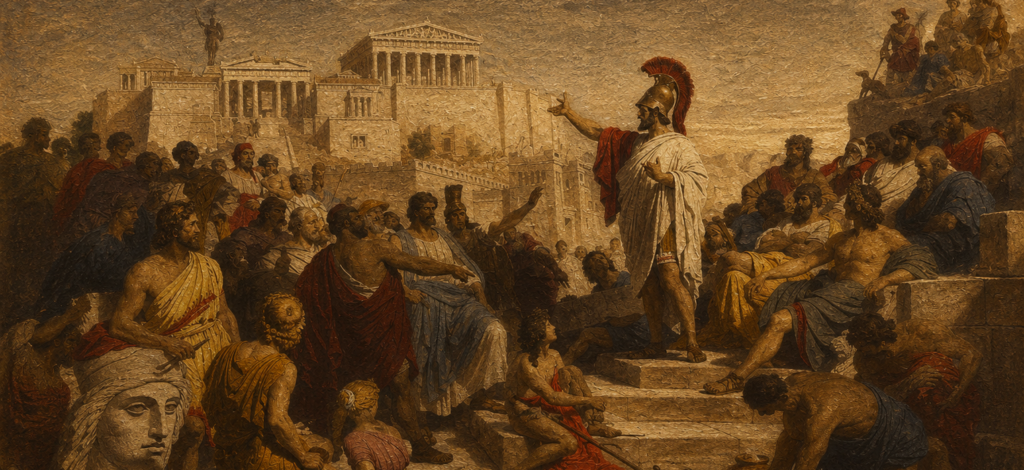
The Holy Matrimony of Faith and Reason by ELP Instructors Jack McPherson & Dani Landivar
At dusk, the fields outside Sparta lie silent.
The city still stands in outward strength, but something within has withered. Along the banks of the Eurotas, an old Spartan watches younger men march through the city gates in perfect formation. Their movements are disciplined. Yet their eyes are hollow. They know how to preserve the city, but no longer know why the city is worth preserving. Sparta may have mastered order, discipline, and military excellence, but even Sparta could not escape decay.
Reason alone can build walls, establish laws, and organize society with remarkable precision, but it cannot finally heal the restless heart of man. Philosophy may point toward the good like a torch in the night, yet the torch flickers in the wind unless lit by a higher flame.
The problem facing the modern West is not merely political, economic, or institutional. It is anthropological. Modern man has forgotten what the human person is, what the human person is for, and how the faculties of the soul are meant to exist in harmony under Truth. We suffer not simply from corruption in our systems, but from fragmentation in our people. We are technologically advanced yet spiritually disoriented, intellectually overstimulated yet philosophically shallow.
Long before Christianity emerged onto the stage of history, the Greeks recognized that political order begins within the person. Socrates, Plato, and Aristotle understood that the polis mirrors the soul. A society cannot remain ordered when its people are internally fractured. Philosophy, therefore, sought harmony between reason and desire, virtue and appetite, contemplation and action. Aristotle observed that man naturally stretches himself out toward knowledge because human beings are ordered toward truth itself.
In the second century, Justin Martyr articulated the idea of logos spermatikos—the “seeds of the Word.” Because creation itself bears rational order, fragments of divine truth were accessible through reason even before Christ entered history. The pagan philosophers were perceiving genuine truths because all truth ultimately flows from the Logos through whom all things were made.
The Greeks could diagnose the disorder of man, but they could not fully heal it. Philosophy could illuminate the path toward virtue, but it lacked the power to restore fallen man to wholeness. Even the wisest among them still found themselves divided against themselves—knowing the good while pursuing the lesser. Reason could identify the wound, but it could not resurrect the soul.
Christianity proclaimed something astonishing: the Bridegroom had entered the scene.
In Jesus Christ, the Logos became flesh. Truth was no longer merely an abstract principle to contemplate, but a living Person to encounter. Christianity did not abolish philosophy; it fulfilled it. What Athens sought through reason, Jerusalem proclaimed through revelation. Faith and reason were no longer estranged voices speaking past one another, but joined together in a holy matrimony bearing witness to the same Truth.
Reason disciplines while faith illuminates. Reason orders the intellect while faith orders the soul toward its ultimate end. Separated from one another, both eventually decay. Faith detached from reason collapses into fanaticism. Reason detached from faith collapses into emptiness.
But united together, they produce integration.
Christ does not merely model the harmony of faith and reason; He makes it possible. Before the Incarnation, the philosopher could reason toward truth but could not be fully reintegrated by it. In Christ, humanity is invited not merely to contemplate the Logos, but to participate in Him.
G.K. Chesterton once described the Church as “one continuous intelligent institution that has been thinking about thinking for two thousand years.” The line endures because it captures something modernity often forgets: Christianity is not hostile to reason, but deeply committed to it. The Christian tradition did not fear inquiry because it believed truth ultimately coheres in God Himself.
More than wit, Chesterton recognized that Christianity is an ongoing participation in Divine Reason itself. If Christ is the Logos, then reason is not impersonal. Reason has a face.
This casts God’s invitation through Isaiah in a striking light: “Come now, let us reason together.” God is not inviting humanity into mere intellectual exercise, but into communion with Himself. To possess “the mind of Christ,” as Paul describes it, is the reintegration of human thought under Divine Reason.
What emerged from the marriage of Athens and Jerusalem was therefore more than theology. It was a civilization. The Christian West inherited both the philosophical search for truth and the revealed knowledge of God, ordering each toward Christ the Logos. From this union emerged cultures capable of cultivating virtue, contemplation, self-government, responsibility, and ordered liberty.
Sparta demonstrated that discipline alone cannot save a people. A society may continue marching in perfect formation long after it has forgotten what it is marching for.
And the same warning now confronts the modern West.
The renewal of civilization will not come through procedural victories alone. Elections matter. Laws matter. Institutions matter. Yet none of these can restore a culture that has forgotten the nature and purpose of the human person. Political renewal begins downstream from personal renewal.
For where faith and reason remain joined in holy matrimony, the human person is drawn toward truth, goodness, and ultimate meaning. And from souls rightly ordered toward truth arise the families, communities, and republics capable of genuine self-government.