
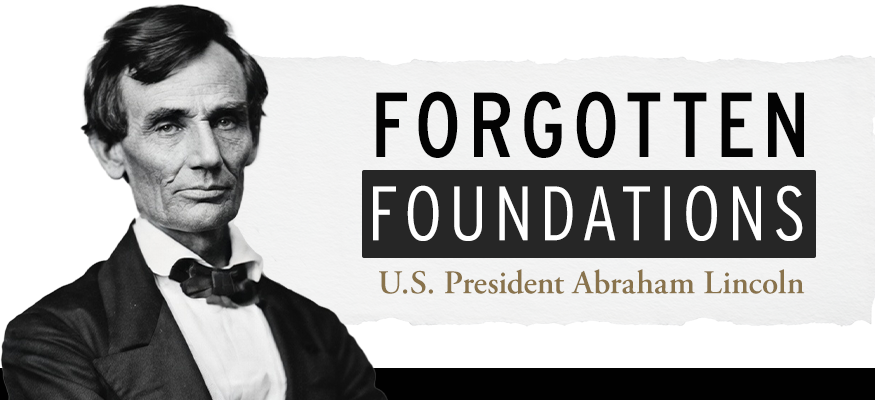
Forgotten Foundations – Jake Fay
Lincoln devotees, admirers of the man’s peerless pen, wit, and rhetoric, have long been tantalized by the so-called “Lost Speech.”
Legend has it that, on May 29, 1856, at the State Convention of the Anti-Nebraska Party in Bloomington, Illinois, Abraham Lincoln delivered a magisterial address so captivating that “spell-bound” reporters forgot to take notes. Others have suggested that Lincoln’s allies deliberately suppressed the speech, fearing it was too radical. Whatever the case, no known copy of the speech exists, depriving scholars and fans of a no doubt singular feat of oratory.
Nevertheless, this borderline mythical speech provides tremendous insight into a truly pivotal moment in history, the rise of the Republican Party, and one man’s personal odyssey from Illinois to the White House.
The Bloomington Address arrived at a volatile moment in American politics. Sen. Stephen Douglas’ 1854 Kansas-Nebraska Act had overturned the Missouri Compromise, upending the precarious balance between Slave and Free States, allowing new territories to decide by “popular sovereignty” whether to permit the “peculiar institution” within their borders, and triggering a wave of violence in states like Kansas (“Bleeding Kansas.”) Opponents, including Lincoln, were thrown into a furious uproar. Leading anti-slavery advocates in Congress, including Sen. Salmon P. Chase of Ohio and Sen. Charles Sumner of Massachusetts, blasted the bill as “a gross violation of a sacred pledge,” “a criminal betrayal of precious rights.”
“We were thunderstruck and stunned; and we reeled and fell in utter confusion,” Lincoln described his allies’ initially dazed response to the downfall of the Missouri Compromise. “But we rose each fighting, grasping whatever he could first reach—a scythe—a pitchfork—a chopping axe, or a butcher’s cleaver. We struck in the direction of the sound; and we are rapidly closing in….”
Drawn together by their shared contempt for the Kansas-Nebraska Act, a loose network of smaller political factions slowly began to coalesce into a single movement, sometimes known as the Anti-Kansas or Opposition Party. This was a good start. But for Lincoln and those who wanted to arrest the spread of slavery into the vulnerable Western territories, it wasn’t enough.
“Mere hatred of slavery and opposition to the injustice of the Kansas-Nebraska legislation were not all that were required of him,” Lincoln’s law partner, William Herndon, observed. “He must be a Democrat, Know-Nothing, Abolitionist, or Republican, or forever float about in the great political sea without compass, rudder, or sail.”
In 1856, various anti-slavery groups in Illinois summoned delegates “for the purpose of making arrangements for the organization of the anti-forces in this State….” A week before they met for the official first Republican State Convention in Illinois, Rep. Preston Brooks, a pro-slavery firebrand from South Carolina, brutally assaulted the aforementioned Charles Sumner on the floor of the Senate — a painful and damning reminder of just how explosive the slavery debate had become. It was high time for the opponents of slavery to unite.
The Bloomington Convention swiftly “endorsed the movement for organizing a new party” and passed a series of resolutions “foregoing all former differences of opinions upon other questions….” These newly minted brother-in-arms pledged themselves in united opposition to the Kansas-Nebraska Act, blasting the repeal of the Missouri Compromise as “unwise and injurious” and pledging, if allowed, to exercise government power “to prevent the extension of slavery into territory heretofore free.”
As president, Lincoln would later profess that, despite his strong personal hatred of slavery, his “paramount object” in the Civil War was to “save the Union.” This foremost emphasis on the Union was already on display at the Bloomington Convention, where delegates affirmed that “we are devoted to the Union and will, to the last extremity, defend it against the efforts now being made … to compass its dissolution….”
These resolutions likely set the tone for Lincoln’s mysterious speech. Rising to speak at the end of the convention, Lincoln, “was here ready to fuse with any one who would unite with him to oppose slave power,” The Alton Weekly Courier reported. Sadly, the newspaper failed to print the text of Lincoln’s speech. He may have quoted a famous Daniel Webster line — “Liberty and Union, now and forever, one and inseparable” — but other than that, very little is remembered of what the virtuoso Illinois Republican said.
The sheer power of his eloquence, however, was unforgettable.
Civil War veteran, Congressman, and Illinois historian Green B. Raum later wrote that the speech was “one of [Lincoln’s] noblest and best efforts; it was extemporaneous, no stenographic record was made of it, but those who heard it remember it as a thrilling oration of argument and eloquence.” Herndon, who claimed familiarity with all of Lincoln’s best speeches, lavished praise on the Bloomington Address as “the grand effort of his life.” His fawning reminiscence of the event is well worth quoting at length:
“Heretofore [Lincoln] had simply argued the slavery question on grounds of policy,—the statesman’s grounds,—never reaching the question of the radical and the eternal right. Now he was newly baptized and freshly born; he had the fervor of a new convert; the smothered flame broke out; enthusiasm unusual to him blazed up; his eyes were aglow with an inspiration; he felt justice; his heart was alive to the right; his sympathies, remarkably deep for him, burst forth, and he stood before the throne of the eternal Right. His speech was full of fire and energy and force; it was logic; it was pathos; it was enthusiasm; it was justice, equity, truth, and right set ablaze by the divine fires of a soul maddened by the wrong; it was hard, heavy, knotty, gnarly, backed with wrath. I attempted for about fifteen minutes as was usual with me then to take notes, but at the end of that time I threw pen and paper away and lived only in the inspiration of the hour. If Mr. Lincoln was six feet, four inches high usually, at Bloomington that day he was seven feet, and inspired at that. From that day to the day of his death he stood firm in the right.”
Herndon later admitted that his earlier description may have sounded hyperbolic, but he stood by the “substantial truthfulness of the scene as described.”
“I have never seen the need of altering a single sentence,” he said.
The fiery birth of the Republican Party in the state now known as the Land of Lincoln was, in many ways, the beginning of a Republican Revolution that would, within a decade, result in the fulfillment of both the preservation of the Union and the abolition of slavery. In addition to giving his show-stopping speech, Lincoln had played the part of a masterly politician, working his behind-the-scenes magic to nominate William H. Bissell, a former Democrat, as the party’s first gubernatorial candidate for Illinois. (Bissell would go on to win that race with Lincoln’s enthusiastic support.)
Just over two weeks later, in Philadelphia, the Republican National Convention selected the swashbuckling but politically inexperienced John C. Frémont to run as the first-ever Republican presidential candidate. (Lincoln was reportedly asked to rewrite his Bloomington speech for the Frémont campaign, but declined due to not remembering the exact words.)
It was an ill-fated election for the newly-formed party; Frémont suffered a humiliating defeat at the hands of Democrat James Buchanan. But perhaps, with such a bright rising star in Illinois — a man already renowned for his impassioned principles, dexterous political know-how, and spellbinding eloquence — the Republicans would enjoy better success in 1860.