
ELP Administrator Dani Landivar
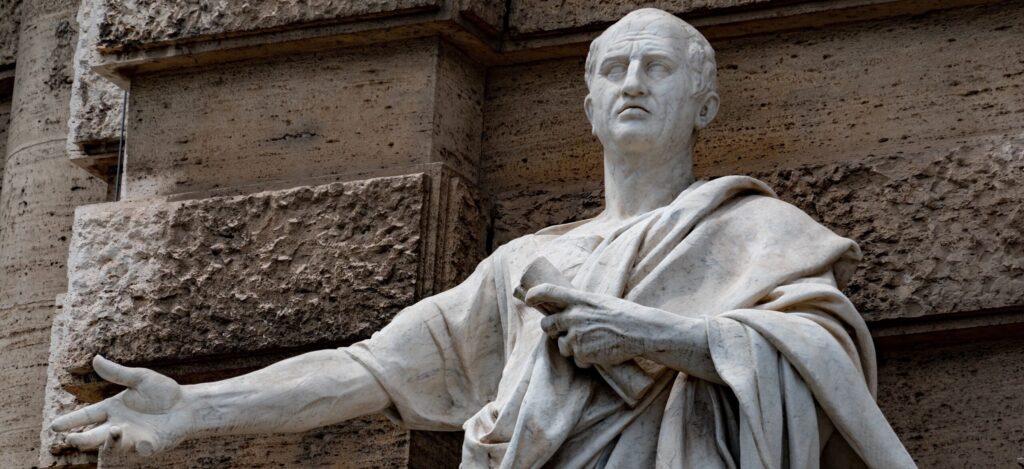
“Although in philosophy many profound and useful ideas have been the subject of subtle and eloquent debates among philosophers, the most widely relevant ones seem to be their lessons and teachings about responsibility… All good actions in life come from maintaining your responsibilities; when you neglect them the result is discredit.” — Marcus Tullius Cicero, De Officiis
What comes to mind when you hear the word duty?
For many, it carries the weight of obligation—something imposed, something to be endured. I remember growing up thinking little more of duty than that: a requirement placed upon me, something expected, something to be fulfilled. And yet, even then, there was a sense that it flowed from a quiet wellspring within, tied to who I am.
What if duty is not merely something required of us, but something that gives shape to a life well lived?
As Cicero argued, all good actions arise from the faithful keeping of our responsibilities—and to neglect them is not neutrality, but discredit. This is a far more demanding vision than the one we often inherit today. For we live in a culture that speaks incessantly of rights, yet grows increasingly silent about the responsibilities that sustain them.
Many desire the benefits of rights—the freedom to speak, to act, to choose—while resisting the obligations that make those freedoms possible. But this separation cannot hold. Rights divorced from responsibilities do not expand freedom; they erode it. They become untethered claims, lacking the moral structure required to sustain them.
Duty—once central to the Good life—has steadily receded, eclipsed by comfort and self-interest. In its absence, we do not find greater liberty, but a quiet unraveling: souls less anchored, thoughts less coherent, and a moral vocabulary that grows thinner with each passing generation.
Cicero offers us an image that helps recover what has been lost. In Of the Laws, he writes of an oak that endures because its roots remain firm, even when unseen. The tree survives not merely because of what is visible, but because of what sustains it beneath the surface.
The moral life is much the same. Its visible fruits—justice, courage, civic friendship—are what we most readily recognize as virtue. But these do not exist on their own. They depend upon something deeper: a root. That root is the moral order itself—natural law, grounded in a reality higher than individual will. Duty is our participation in that order. It is the means by which the root nourishes the tree. A life rooted in duty—anchored in something higher and more stable—offers not only coherence, but the possibility of true and lasting flourishing.
When duty is forgotten, the root is severed. And when the root is severed, the language of rights begins to hollow out. We continue to assert them, even expand them, but they lose their coherence—because we have lost sight of what justifies them in the first place.
Here, philosophy rightly understood becomes indispensable. For philosophy is not merely the love of abstract thought, but the pursuit of wisdom about how one ought to live. And that pursuit inevitably directs us outward. It asks not only what we may claim, but what we owe.
The lives of great statesmen make this truth visible. John Quincy Adams, after serving as President of the United States, did not retire into comfort. Instead, he returned to Congress, driven by a singular purpose: to oppose slavery. When asked why he continued despite resistance and little visible success, his answer was simple: “Duty is ours; results are God’s.”
For years, he labored with little to show for it. He died in Congress after more than a decade of effort, never seeing the fruits of his work. And yet his influence endured. What Adams began in duty, Lincoln would later bring to fulfillment.
This is the nature of duty. It is not measured by immediate outcomes. It is grounded in faithfulness. The seeds we plant may take root in ways we will never see. But that does not diminish the obligation to plant them.
And so duty extends beyond politics into every dimension of life. It reaches into our communities, our relationships, and our inner lives. Our civic responsibilities are not isolated burdens; they are expressions of a deeper truth—that we are accountable not only to ourselves, but to something higher.
As Rev. Matthias Burnet declared in his 1803 Election Sermon before the Connecticut legislature, “To God and posterity you are accountable for your rights and your rulers.” It is a sobering reminder: what we inherit, we are called to steward. What we steward, we will one day pass on.
Duty, then, is not a relic of the past. It is a forgotten virtue—and one urgently in need of recovery. For rights cannot endure where responsibility is denied.
But when the root is restored, the tree can grow.