
This concludes our series examining the effects of religion on early America. Catch up on the previous installments below:
‘A Great Awakening’ Movie Review: Roots of Self-Government
Why Faith Was Central to America’s Founding
Revival Before Revolution
The enigmatic but ubiquitous phrase “a wall of separation between Church & State” has long perplexed and divided Americans. Although the expression appears neither in the Declaration of Independence nor the Constitution, it succinctly summarizes the First Amendment’s establishment clause: “Congress shall make no law respecting an establishment of religion, or prohibiting the free exercise thereof.” In a 1879 Supreme Court case regarding Mormon polygamy, Chief Justice Morrison Waite endorsed the now-famous phrase “as an authoritative declaration of the scope and effect of the [First] amendment….”
As previously discussed, our ancestors believed, in the words of Thomas Jefferson, “that religion is a matter which lies solely between Man & his God….” Consequently, they forbade the government from sticking its nose into America’s churches. Simultaneously, they believed that religion served as a useful instrument for cultivating virtue, an indispensable support for a free country. Somehow, without coercing religion, the United States would have to find a way to promote pure morals, incentivize self-government, and mitigate crime.
The separation between Church and State, at its best, should be understood as a balancing act; in the final part of this series, we will seek to understand how Founding-Era leaders walked that line.
Jefferson, Madison, and Leland
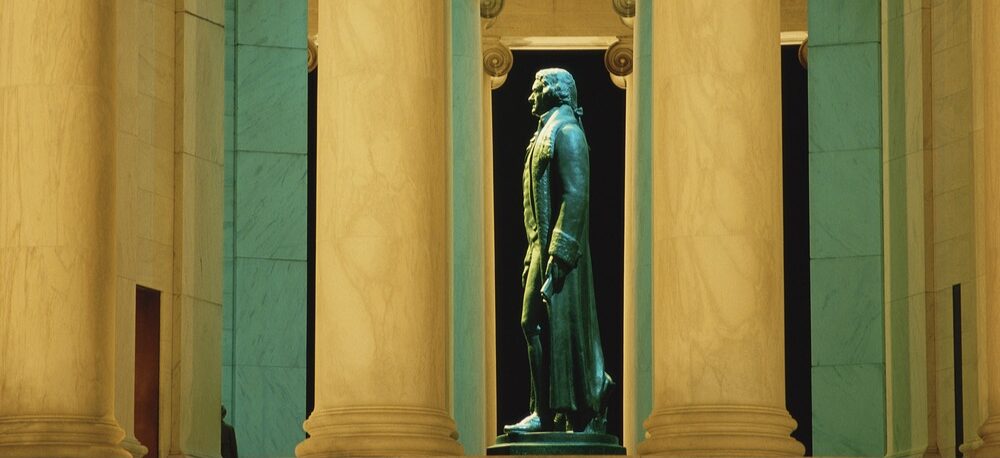
America has never had an official state religion. Between the first meeting of the House of Burgesses in 1619 and the passage of Amendment XI of the Massachusetts Constitution in 1833, however, individual states sometimes allowed official state churches. These establishment institutions — the Church of England in Virginia, Established Congregationalism in New England — tested the ideas of freedom of conscience and freedom of worship, leading secular crusaders and pious reformers to campaign for greater independence between religious and civic bodies. Thomas Jefferson and James Madison, working with smaller, non-establishment evangelical sects, helped lead the charge.
A chief advocate of the disestablishment of Anglicanism in Virginia, Jefferson drafted the 1786 Virginia Statute for Religious Freedom, a foundational text that foreshadowed the First Amendment. Jefferson considered it one of his greatest accomplishments. It was obvious to the author of the Declaration of Independence, who again employed words of soaring eloquence and deep moral weight, “that all attempts to influence [the mind] by temporal punishments, or burthens, or by civil incapacitations, tend only to beget habits of hypocrisy and meanness….” Notably, Jefferson argued, “the holy author of our religion” had not forced Christianity on others, though it was well within “his Almighty power” to do so.
He registered other concerns as well: it was presumptuous of “fallible” lawmakers to exercise “dominion over the faith of others”; it was offensive to tax a man for “the propagation of opinions which he disbelieves and abhors.” The idea of a state establishment of religion was problematic, not because Jefferson disliked religion, but because it restricted the free exercise of religion for those who fell outside of the established sect.
Accordingly, the General Assembly of Virginia ordered that “no man shall be compelled to frequent or support any religious worship, place, or ministry whatsoever, nor shall be enforced, restrained, molested, or burthened in his body or goods, nor shall otherwise suffer, on account of his religious opinions or belief; but that all men shall be free to profess, and by argument to maintain, their opinions in matters of religion, and that the same shall in no wise diminish, enlarge, or affect their civil capacities.”
Although these were Jefferson’s words, he had been in France when the General Assembly adopted them; it was Madison who walked the bill through the legislative process.
The future “father of the Constitution” had been working towards this moment for at least a decade, having edited George Mason’s 1776 Virginia Declaration of Rights to ensure the “free exercise of religion” instead of the “fullest Toleration,” which implied that the orthodox/establishment church (the Anglican Church, in that case) had received the right merely to tolerate politically inferior denominations.
In 1785, Madison anonymously drafted the Memorial and Remonstrance Against Religious Assessments, an influential document opposing the Patrick Henry-backed “Bill establishing provisions for Teachers of the Christian Religion.” It was a sensitive topic. Madison masked his authorship of the exquisite document, a towering achievement in Founding-Era philosophy, likely recognizing the risks of publicly opposing such an explicitly Christian bill. Brilliant, measured, and meticulous, his Remonstrance carefully detailed 15 reasons why he believed a blurry line between Church and State threatened not only civil authorities but religious ones, as well. It was, in other words, in the Church’s best interest to maintain a wall of separation.
Madison’s declaration helped pave the way for the disestablishment of the Church of England in Virginia, a pivotal moment in America’s progressive departure from Europe’s often violent religious past. It’s important to note that Christian dissidents — groups like the Baptists and Presbyterians — wanted this. They wanted equal protection under the law, regardless of their denomination. Major evangelical leaders, including the Baptist minister John Leland, emerged as key allies in the fight to break up the Church of England in the Old Dominion.
Leland knew what it was like to face persecution simply for falling into the “wrong” sect. “In 1774, when Leland was converted to the Baptist faith,” L.H. Butterfield, editor-in-chief of The Adams Papers, wrote, “the Baptists were generally regarded as a set of ignorant enthusiasts, without social standing, without legal sanction for their religious services or for marriages performed by their ministers. In Virginia Baptist preachers were being regularly thrown into prison as strollers and vagabonds; mob actions breaking up their services went unpunished by the magistrates; their petitions to the legislature for relief from these oppressions were largely disregarded.” This rank inequality turned Leland into an outspoken opponent of the oppressive establishment system — “the worst hag above hell,” he called it.
“The notion of a Christian commonwealth should be exploded forever,” he wrote. “Government should protect every man in thinking and speaking freely, and see that one does not abuse another. The liberty I contend for is more than toleration. The very idea of toleration is despicable; it supposes that some have a pre-eminence above the rest to grant indulgence, whereas all should be equally free, Jews, Turks, Pagans and Christians.”
He and Madison contested the idea that Christianity required the protections of the state in order to survive. Historically, they countered, Christianity had actually prospered when earthly governments opposed it. True religion would do just fine with or without the state’s stamp of approval.
While many evangelicals applauded the death of establishment churches, others detected a coded plea for a godless, secular society. Jefferson, a man whose own religious views were highly ambivalent, bore the brunt of those attacks. In the heated presidential campaign of 1800, Federalists caricatured the Sage of Monticello as a “howling atheist,” an enemy of the faith, a grotesque pagan who worshiped at the altar of reason. One newspaper neatly summarized that year’s election as a choice between “GOD—AND A RELIGIOUS PRESIDENT (Jefferson’s opponent, John Adams)” or “JEFFERSON—AND NO GOD.”
The nation went with Jefferson.
The Federalist parody of the man notwithstanding, Christians who still faced unequal treatment in states with establishment churches hailed Jefferson’s election as an open door for greater liberty. As the Danbury Baptist Association in the State of Connecticut professed to the new president, “America’s God has raised you up to fill the chair of State out of that good will which he bears to the Millions which you preside over.” No doubt impressed by the Virginia Statute for Religious Freedom, the Connecticut Christians expressed hope that Jefferson would dissolve Congregationalist hierarchies in New England.
Jefferson, who agreed with the Baptists that “no man ought to suffer in Name, person or effects on account of his religious Opinions,” saw an opportunity to clean up his reputation as a raging infidel.
“Believing with you,” he wrote in his timeless response, “that religion is a matter which lies solely between Man & his God, that he owes account to none other for his faith or his worship, that the legitimate powers of government reach actions only, & not opinions, I contemplate with sovereign reverence that act of the whole American people which declared that their legislature should ‘make no law respecting an establishment of religion, or prohibiting the free exercise thereof,’ thus building a wall of separation between Church & State.” He promised to “reciprocate” their prayers, and threw in “assurances of my high respect & esteem” for their denomination.
Borrowing from Locke, Leland, and his own past work, Jefferson could not have known that his simple commentary on the First Amendment would eventually attain the status of an authoritative American maxim. But Jefferson’s words, once again, proved immortal.
In the short term, they simply helped win elections. Jefferson’s fabled support for religious liberty and Leland’s emphatic political activism nailed down the Baptist vote for the Democratic-Republican Party in regions still under the sway of the Congregationalist Church. Legend has it that Chester, Massachusetts, where Leland preached, turned out so loyally for Republicans that a lone Federalist vote was cast out as a presumed mistake. In 1801, the year Jefferson mailed his now-famous letter to the Danbury Baptists, Chester offered a whopping zero votes to the state’s Federalist Governor Caleb Strong.
Unfortunately, the Bay State didn’t disestablish Congregationalism until 1833 — a capstone on the generational fight for true religious liberty in America. It’s noteworthy that Leland, an active minister, was intimately involved in that fight, preaching, petitioning, protesting, and parading his congregation to the polls.
In one of the most famous Leland stories, the Baptist minister conveyed a massive, 1,230-lb. cheese to the nation’s capital to deliver to the president, arriving on the same day that Jefferson sent his “wall of separation” letter. Preaching to and from Washington, Leland wanted to honor the man he saw as an unlikely Moses, leading God’s people out of the Egypt of establishment oppression. Jefferson must have been moved by the gesture (he called it “an ebullition of the passion of republicanism in a state where it has been under heavy persecution”) and invited Leland to preach to Congress. Leland, the virulent opponent of state-sponsored religion, accepted, and Jefferson, the religious maverick, attended the message — all just days after celebrating the “wall of separation between Church & State.”
Clearly, whatever that phrase meant to its author and the men who pushed the hardest to abolish illiberal religious establishments, it was never meant to keep voices like Leland’s from the public square.
There was, after all, a huge difference between the establishment of religion and the free exercise thereof.