
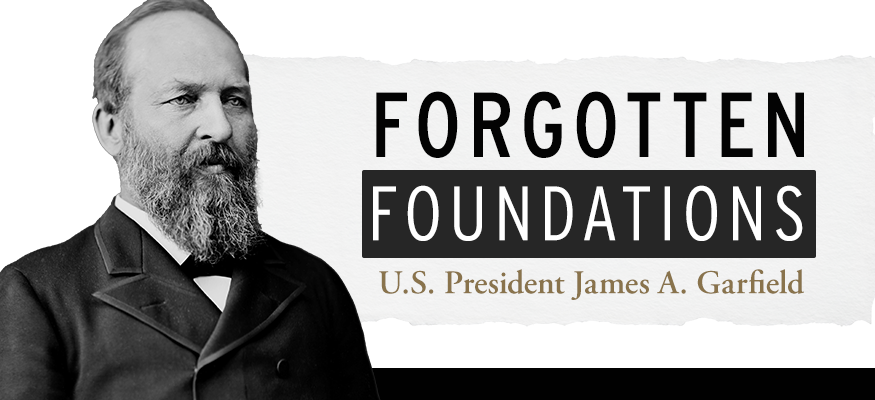
Although the compelling and well-cast Netflix series about his unlikely election and all-too-brief term in office may have temporarily bolstered his profile, most Americans do not realize that James A. Garfield was one of the most intelligent, accomplished, and honorable men to ever hold the presidency.
The last president to have been born in a log cabin, Garfield overcame debilitating poverty and hardship to become, among other things, an ordained minister, a college president, a decorated major general in the Civil War, and a longtime member of the U.S. House of Representatives. He was also elected to the U.S. Senate, but did not serve as he ended up as president instead.
He was also a steadfast defender of civil rights for all Americans, and did not shirk that responsibility during his inaugural address, delivered on the East Portico of the Capitol on March 4, 1881.
Garfield’s eloquent speech has unfortunately been largely lost to history. That is a crying shame because it stands as one of the finest restatements of full citizenship and civil rights and stoutest defenses of the Fifteenth Amendment, which stated plainly that a U.S. citizen’s right to vote “shall not be denied or abridged by the United States or by any State on account of race, color, or previous condition of servitude.”
While Garfield was only president for less than a year when he died after being shot by delusional and deranged assassin Charles Guiteau, he took the opportunity to utilize his first message to the American people as chief executive to speak with strength and clarity.
While the Fifteenth Amendment was seen by many as the last piece of Reconstruction, it was flatly ignored in many southern states. Several Congresses, the Supreme Court, and presidential administrations refused to reaffirm or enforce its plain language. Worse, free black Americans were subjected to unlawful and humiliating literacy tests, ridiculous poll taxes, intimidation, and outright violence in order to prevent the franchise from being exercised and the possibility of proper representation in the counsels of government.
Garfield recognized the significance of the Fifteenth Amendment as a matter of law and the importance of recognizing former slaves as full-fledged citizens who were entitled to enjoy the rights of a free people.
As Garfield said:
“…the elevation of the Negro race from slavery to the full rights of citizenship is the most important political change we have known since the adoption of the Constitution in 1787…Those who resisted the change should remember that under our institutions there was no middle ground for the Negro race between slavery and equal citizenship. There can be no permanent disenfranchised peasantry in the United States.”
Garfield vowed that his administration would see that all American citizens would enjoy the full guarantees of the Constitution, and directly addressed states and localities that would deny the vote in defiance of the Constitution:
“The free enjoyment of equal suffrage is still in question, and a frank statement of the issue may aid its solution. It is alleged that in many communities negro citizens are practically denied the freedom of the ballot. In so far as the truth of this allegation is admitted, it is answered that in many places honest local government is impossible if the mass of uneducated negroes are allowed to vote. These are grave allegations. So far as the latter is true, it is the only palliation that can be offered for opposing the freedom of the ballot.
“Bad local government is certainly a great evil, which ought to be prevented; but to violate the freedom and sanctities of the suffrage is more than an evil. It is a crime which, if persisted in, will destroy the Government itself. Suicide is not a remedy. If in other lands it be high treason to compass the death of the king, it shall be counted no less a crime here to strangle our sovereign power and stifle its voice.”
Garfield no less boldly warned those precincts that would “destroy the government itself” by denying anyone the right to vote. He asked “We may hasten or we may retard, but we can not prevent, the final reconciliation. Is it not possible for us now to make a truce with time by anticipating and accepting its inevitable verdict?”
Guiteau stilled Garfield’s voice, and his immediate successors were not remotely as committed as he to putting the full force of executive power behind the Fifteenth Amendment. Indignities such as poll taxes, literacy tests, grandfather clauses, and property qualifications persisted as black Americans were continually denied the vote.
It would not be until the Voting Rights Act of 1965 was passed by Congress that such practices as literacy tests were explicitly prohibited, enforcing the Fifteenth Amendment. The legislation came on the heels of the ratification of the Twenty-fourth Amendment, which explicitly prohibited “any poll tax or other tax” in order to vote in federal elections.
Could all of that have been prevented had Garfield survived to serve one or two terms? It is folly to speculate, though given the powerful commitment to what he saw as the upholding the promises of the Constitution, it is no exaggeration to say that his murder and the end of his administration is one of the greatest “what-ifs” in American politics.
James Garfield – nor the words of his inaugural address – should not be confined to the recesses of history. Both should be celebrated and amplified as among the finest that the republic has had to offer during our 250 years of independence.