
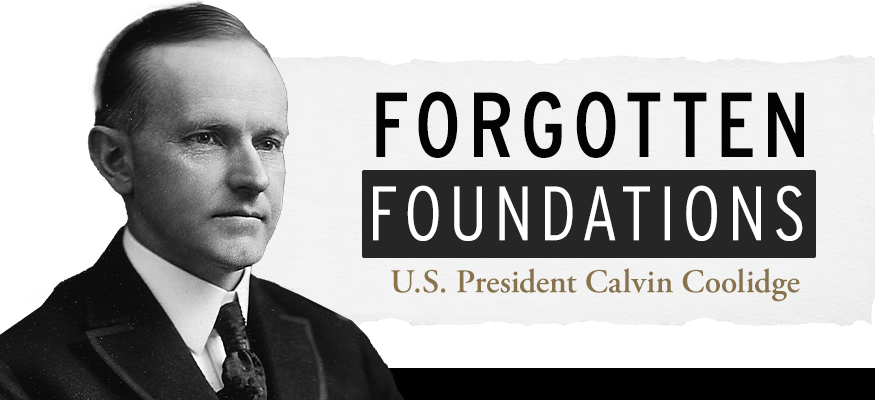
Calvin Coolidge and the citizen-legislator
“Perception is reality.”
Calvin Coolidge understood the same.
Although nearly a century has passed since he left the White House, few American political figures are as closely associated with fiscal responsibility as Coolidge, who was as guarded with public funds as he was with public utterances.
Upon succeeding to the presidency following the death of Warren G. Harding, whose administration had been mired in scandals generated by several of his appointed cronies who were unable to resist bribes and favoritism, Coolidge declared in his clipped style:
“We must have no carelessness in our dealings with public property or the expenditure of public money. Such a condition is characteristic of undeveloped people, or of a decadent generation.”
Coolidge’s prudence was more than an ingrained trait of a flinty New Englander. It was an essential part of his political philosophy, his vision of public service, and the importance of the appearance of propriety. While such a stance may have been a punchline in the smoke-filled rooms of the political bosses of the day, it was an ethos that Coolidge honed with solemnity and lived from his earliest days in Vermont and during his time in office in Massachusetts.
Too often we have learned about countless members of Congress who have not only pushed this nation further into debt, but curiously added to their private fortunes during their time in office. So many treat the United States Treasury as a personal bank while bearing gifts to their highest donors. Others whine about how difficult it is to get by in Washington, D.C., on the six-figure salary that they are paid by the people.
Such members of Congress use that power to overwhelm lesser-known and vastly underfunded candidates who attempt to unseat them. They come to regard their constant re-election to office as not a gift from the public, but a birthright.
Those members – and, truly, all of us – would do well to be reminded of a veto message that Coolidge sent to the Massachusetts General Court during his time as governor of the Bay State.
In 1919, a legislator in Massachusetts earned $1,000 annually plus travel expenses to and from Boston for the part-time position. That year, a bill known as House No. 1629 was passed by the General Court. The legislators had voted themselves an eye-popping 50 percent raise to $1,500.
As he wrote in part:
“Service in the General Court is not obligatory but optional. It is not to be undertaken as a profession or a means of livelihood…
“Membership in the General Court is not a job. There are services rendered to the Commonwealth by senators and representatives that are priceless. For the searching out of great principles on which legislation is based there is no adequate compensation…When membership is sought as a means of livelihood, legislation will pass from a public function to a private enterprise…
“The realities of life are not measured by dollars and cents. The skill of the physician, the divine eloquence of the clergyman, the courage of the soldier, that which we call character in all men, are not matters of hire and salary. No person was honored for what he received. Honor has been the reward for what he gave…
“The place each member of the General Court will hold in the estimation of his constituents will never depend on his salary, but on the ability and integrity with which he does his duty; not on what he receives, but on what he gives; and only out of the bountifulness of his own giving will his constituents raise him to power.”
Appearances cannot be disregarded. Those in whom is placed the solemn duty of caring for others ought to think of themselves last or their decisions will lack authority…It is of infinite importance to demonstrate that legislation is used not for the benefit of the legislator, but of the public.”
During this 250th anniversary of our republic, let us endeavor to remind ourselves and our representatives of the standard to which we must all strive to reach – the standard that Calvin Coolidge defined and met. His veto message stands apart as not only a logical response to a clear act of fiscal irresponsibility, but an elegantly concise and timeless restatement that in matters of financial prudence and personal integrity, the actions taken by, as well as the appearances of, representatives of the people must always be for the public good.